High-density polyethylene tensile strength typically falls between 20 and 37 MPa, depending on grade, molecular weight, and how the specimen is loaded. That range is wide because HDPE is a semi-crystalline polymer whose behavior is sensitive to test speed, temperature, and grip alignment — three variables that operators control by hand in a traditional lab. At LabsCubed we build CubeOne and CubeTen to remove that operator-to-operator variability, so QA teams get repeatable numbers instead of only faster ones.
This guide covers the values you should expect from HDPE, how the number is measured under ASTM D638 and ISO 527, why two labs testing the same resin can report different results, and how automation stabilizes the workflow from specimen loading through data acquisition.
What is high-density polyethylene tensile strength?
High-density polyethylene tensile strength is the maximum tensile stress an HDPE specimen sustains before yielding (yield strength) or breaking (ultimate strength), reported in MPa or psi. Because HDPE is ductile, the stress-strain curve shows a clear yield point followed by a long draw region, so results typically report both yield and ultimate values.
HDPE tensile strength depends on density (0.941–0.965 g/cm³), molecular weight distribution, degree of crystallinity, and any additives or fillers. Injection-molded parts often behave differently than extruded pipe or blow-molded bottles because processing history changes crystallinity and orientation. A number without those conditions attached is close to meaningless for engineering decisions.
What are typical HDPE tensile strength values?
Typical HDPE tensile strength values run 20–37 MPa at yield and up to 45 MPa at ultimate for standard commercial grades tested to ASTM D638 at 23 °C. Film and pipe grades sit at the lower end; high molecular weight and high-density copolymers sit at the top. The numbers below are approximate ranges from published data sheets and MatWeb aggregates covering 200+ grades.
| Property | Typical range | Best-fit grade |
|---|---|---|
| Yield tensile strength | 20–32 MPa (2,900–4,600 psi) | HMWPE, copolymer |
| Ultimate tensile strength | 22–45 MPa (3,200–6,500 psi) | Reinforced HDPE |
| Tensile modulus | 0.8–1.4 GPa | Talc-filled |
| Elongation at yield | ~9–15% | Injection grades |
| Elongation at break | Up to 800% | Blow-molding |
These are typical numbers, not spec limits. Reinforced HDPE (talc, glass) or high molecular weight HDPE (HMWPE) can exceed 40 MPa yield, while recycled or heavily pigmented grades often report lower. Always test your own grade at your own processing conditions before using a value in a design margin.
How is HDPE tensile strength measured?
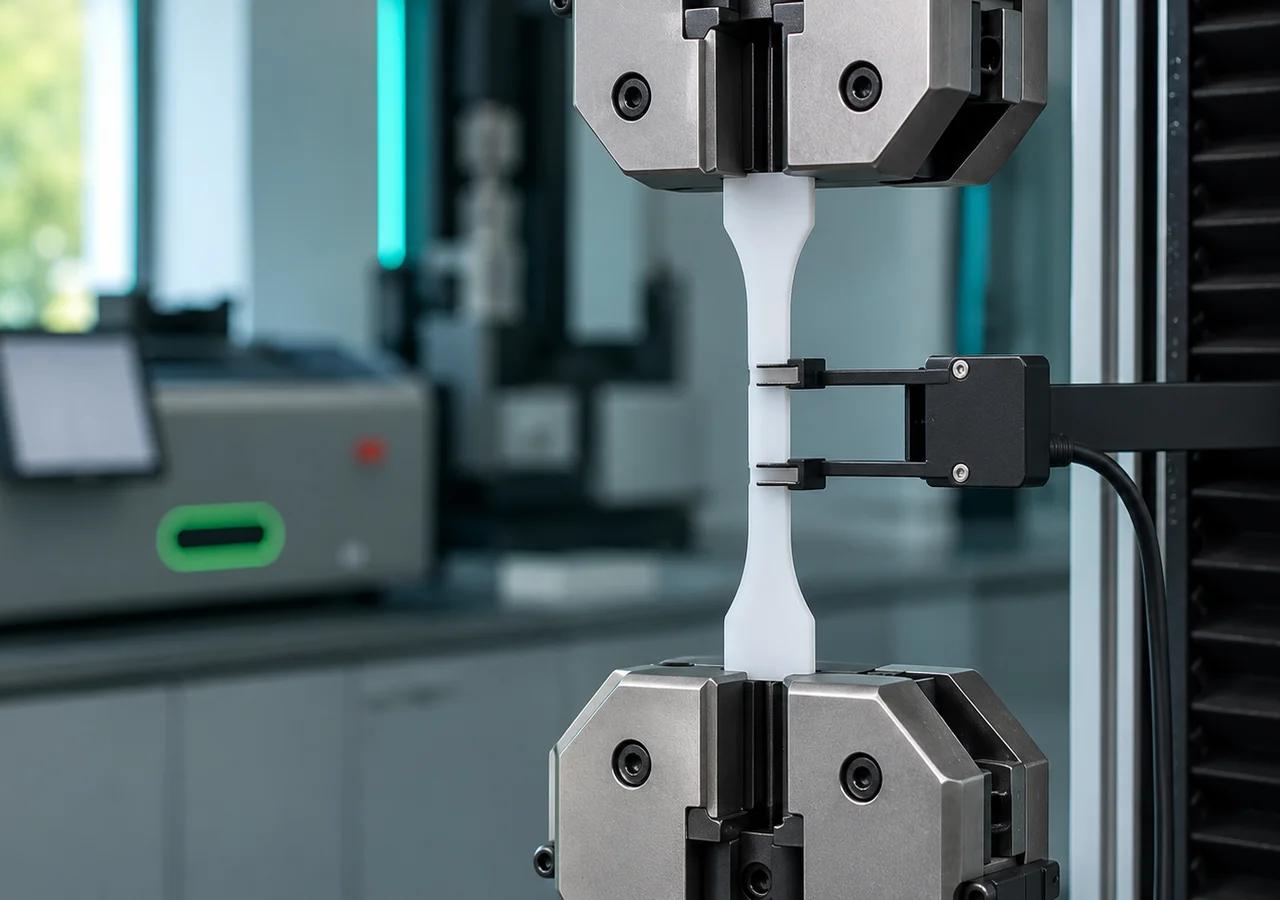
HDPE tensile strength is measured on a universal testing machine by pulling a dog-bone specimen at a controlled speed until it yields or breaks, then recording peak force divided by the original cross-sectional area. In North America the governing method is ASTM D638; ISO 527 is the international equivalent and produces closely comparable results with harmonized specimen types.
The standard procedure:
- Condition specimens at 23 ± 2 °C and 50 ± 5% relative humidity for at least 40 hours before testing. HDPE creeps under load, and conditioning aligns baseline behavior across labs.
- Machine the specimen to ASTM D638 Type IV or Type V geometry (Type IV is standard for most HDPE grades under 14 mm thick). Verify width and thickness at three points along the gauge length; specimen tolerance dominates uncertainty more than the load cell.
- Load the specimen in wedge or pneumatic grips, aligned so the tensile axis is perpendicular to the grip face. Misalignment introduces bending stress that reads as reduced tensile strength.
- Pull at 50 mm/min for Type IV (or as specified for the grade). Higher strain rates push apparent yield strength up because HDPE is viscoelastic.
- Record force vs. extension, then calculate yield stress at the first peak and ultimate stress at break. Use an extensometer or video-extensometer for accurate modulus and elongation values; grip-to-grip displacement understates specimen strain because of grip slippage and machine compliance.
For a broader walkthrough of the test setup, see our polymer tensile test procedure guide and the pillar page on ASTM D638 and ISO 527 tensile testing.
Why does HDPE tensile strength vary between labs?
Two labs testing the same HDPE resin often report tensile strength results that differ by 10–20%, and the gap is almost always operator- and setup-driven rather than material-driven. HDPE is more sensitive to test conditions than harder plastics because the yield point sits in a strain-rate- and temperature-dependent regime.
The most common sources of variability:
- Specimen preparation. Rough edges from CNC milling or die-cutting create stress concentrations that lower the ultimate value. Cross-section tolerance directly changes the calculated stress.
- Conditioning. An HDPE bar pulled straight off the injection press behaves differently than one conditioned 40 hours — residual stress relaxes during conditioning.
- Strain rate. Pulling at 500 mm/min instead of 50 mm/min can raise apparent yield strength by up to 15%.
- Temperature and humidity. HDPE tensile strength typically drops as ambient temperature climbs above 23 °C. See our note on how temperature and humidity affect tensile strength in plastics.
- Grip alignment. Even a couple of degrees of misalignment introduces a bending component that reads as premature yield.
- Operator technique. Manual specimen loading, extensometer clip-on, and start/stop timing vary between technicians and between shifts. This is the variance automation is designed to remove.
Manual vs. automated HDPE tensile testing
Manual tensile testing produces reliable results in the hands of an experienced technician, but throughput and repeatability drop as sample volume rises or when multiple operators share the machine. Automated systems like LabsCubed CubeOne and CubeTen handle specimen loading, alignment, and data logging so the human variance disappears from the numbers.
| Manual tensile testing |
Recommended CubeOne / CubeTen |
|
|---|---|---|
| Specimens per shift | ~30–60, depending on operator | Up to 200+ unattended |
| Operator-to-operator variability | Present at every step | Removed — repeatable alignment every cycle |
| Data capture | Manual export, transcription risk | Automatic logging, per-specimen audit trail |
| Unattended runs | ||
| Best fit | R&D exploration, one-off failure analysis | Production QA, batch testing, regulatory work |
Automation matters most for HDPE because the material's ductility means each test can take 60–120 seconds to reach break, and elongation values require operator patience that automation supplies by default. Read the broader breakdown in our automated tensile testing guide.
Common mistakes when testing HDPE tensile strength
Most HDPE tensile results that look wrong are the result of one of a few repeat mistakes. Fixing them requires no new equipment — only tighter setup discipline (or an automated cell that enforces it).
- Reading only the peak force. HDPE's ultimate stress often occurs during draw, well past yield. Report both yield and ultimate; a single number hides half the story.
- Ignoring conditioning. Testing straight from the mold produces higher scatter and higher apparent yield — the 40-hour conditioning step is not optional.
- Using grip-to-grip displacement for modulus. HDPE stretches, grips slip, and the machine frame compliance adds to the total. Always use a clip-on or video extensometer for modulus and elongation.
- Wrong specimen geometry. Sheet-cut Type I specimens machined too aggressively lose tensile strength to edge damage. Confirm the standard specifies your specimen type for the thickness you have.
- Testing at inconsistent speeds. HDPE is rate-sensitive. Mixing 50 mm/min and 500 mm/min results in the same report obscures the trend.
- Skipping grip alignment checks. Wedge grips drift after hundreds of cycles. A quarterly alignment check catches the drift before it shows up in your QA data.
Frequently asked questions
Is HDPE better than PP for tensile strength?
HDPE generally has higher yield tensile strength than polypropylene, typically 25–32 MPa versus 25–28 MPa for homopolymer PP under the same test conditions. PP wins on stiffness at temperatures above 60 °C, while HDPE holds its yield strength better in cold service. For a direct comparison see our tensile strength of polypropylene guide.
Is HDPE stronger than steel?
No. Structural steel has tensile strength around 400–550 MPa, roughly 15× higher than HDPE. On a strength-to-weight basis HDPE narrows the gap because its density is about one-eighth that of steel, which is why HDPE pipe and geomembrane replace steel in some corrosion-heavy service. Absolute tensile strength is still no match.
What is HDPE's Young's modulus?
HDPE Young's modulus typically ranges from 0.8 to 1.4 GPa for unfilled commercial grades, measured per ASTM D638 with a clip-on or video extensometer. Reinforced grades with talc or glass can reach 2 GPa. Modulus is a small-strain property, so an accurate extensometer matters more than for peak stress.
What is HDPE's elongation at break?
HDPE elongation at break typically runs 100–800% depending on grade and strain rate. Blow-molding grades reach the highest elongations, while injection grades with high melt flow index sit at the lower end. Elongation is the most operator-sensitive value on the report — extensometer placement and slip alone can move it by 30%.
How much weight can HDPE hold?
Load capacity depends on cross-sectional area and load type. As a rough guide, a 1 cm² HDPE cross-section carries about 2,000–3,000 N in tension at yield — but that assumes ideal loading, room temperature, and short duration. HDPE creeps under sustained load, so long-term design values are typically 30–50% of yield strength.
Run HDPE tensile testing without the drift.
CubeOne and CubeTen automate specimen loading, grip alignment, and data logging so QA teams pull repeatable numbers every shift. Book a 20-minute walkthrough with your standards, your materials and your numbers.